
School shade sails
Canopies & Shelters Ltd supplies and installs shade sails and sun protection for schools, giving playgrounds and outdoor dining areas UV shade over the summer. We also make solid-roof canopies where all-weather cover is the priority.
- Shade sails for warm-weather UV protection
- Solid polycarbonate canopy option, ~99% UV filter
- Powder-coated frames in your school colours
- For playgrounds, MUGAs and dining areas
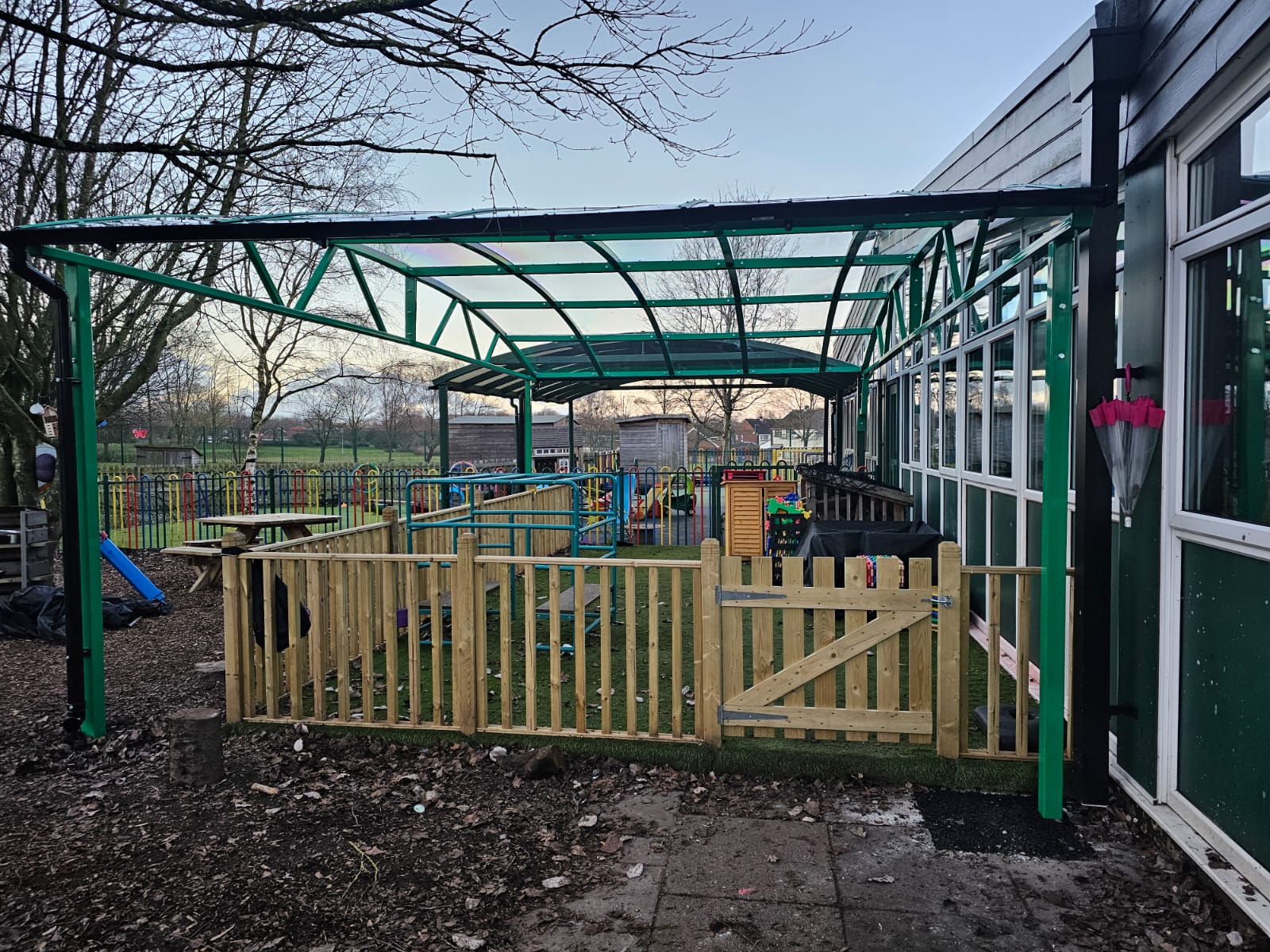
What is school shade?
School shade is a tensioned fabric shade sail or a solid-roof canopy fitted over a playground, dining terrace or early-years garden to cut UV exposure and give pupils a cooler space to play, eat and learn in the summer term.
We supply and install both forms of school shade: tensioned fabric shade sails for warm-weather sun protection, and solid-roof school canopies for cover that works in rain as well as sun. Every project starts with the outdoor space you want to shade and how pupils use it through the year.
What is the difference between a shade sail and a canopy?
A shade sail is a tensioned fabric membrane stretched between fixing points to filter UV over a playground or dining area, while a canopy is a solid, all-weather roofed structure on a powder-coated steel frame that keeps the same space dry in rain as well as shaded in sun.
The shade sail is the lighter, more seasonal option: fabric rather than sheet roofing, open at the edges, and best suited to sun protection during the warmer months. The canopy is the permanent, year-round option: a 5mm or 8mm polycarbonate roof with a 99% UV filter that also sheds rain, so it extends outdoor play, dining or teaching whatever the forecast. Neither is universally better, the right choice depends on whether rain cover matters as much as sun protection for your site.
Which school shade is best?
The best school shade depends on four things: the season the space is used most, whether rain cover matters as well as sun protection, the budget available, and how the area is used, a lunchtime dining terrace, an early-years garden or a playground.
For a summer dining terrace or a seating area used mainly in warm weather, a tensioned fabric shade sail usually gives the best UV protection for the lowest cost. For a playground, MUGA or dining space that needs to stay usable through a British autumn and winter, a solid-roof playground canopy is the better fit because it adds all-weather cover, not just shade. We will advise on the right specification once we know the space and how staff and pupils use it.
How much does school shade cost?
A tensioned fabric shade sail costs from around £1,500 for a single sail over a small dining or seating area, rising with the number of sails and the span, while a solid-roof canopy covering a similar playground or dining space typically costs £8,000 to £30,000 installed. These are indicative ranges to confirm at a site survey, not fixed prices, because the cost moves with the area covered, the number of fixing points, the frame material and any groundworks.
Shade sails are lower cost than solid canopies mainly because the fabric membrane and its fixings use far less material than a steel-framed, sheet-roofed structure, and they need less groundwork. Four things drive the figure for either option: the size of the area to be covered, the number of sails or the roof span, the fixing method (posts, wall brackets or an existing structure) and site access. We quote every project after a survey and provide a written quotation.
| School shade type | Indicative installed cost | Main cost drivers |
|---|---|---|
| Single shade sail | from £1,500 | span, fixing points, fabric grade |
| Multi-sail shade area | £3,000 to £8,000 | number of sails, area covered, posts |
| Solid-roof playground or dining canopy | £8,000 to £30,000 | clear span, roof area, groundworks |
Indicative UK ranges to confirm at survey, installed and excluding any enabling works. Our work is quote-based; we do not sell fixed-price units.
Do shade sails need planning permission?
A shade sail on a school site can fall outside the domestic permitted-development rights that apply to a house, so larger sail structures, listed buildings, conservation areas and anything fixed to a protected elevation may need a planning application, while a smaller sail on posts within the grounds is often lower risk than a solid canopy of the same footprint.
Because a shade sail carries less structural loading than a solid-roof canopy, building-regulations sign-off is typically more straightforward, though it still depends on the size, the fixing method and the site. We supply the CAD drawings and specification your planning consultant or building-control officer needs, and we advise early on what a particular project is likely to require.
How is school shade installed?
We install school shade sails and canopies with our own teams across England, Scotland and Wales in four stages: a site survey, a CAD design and specification for sign-off, UK manufacture of the sail, frame or roof, then the on-site fit. A shade sail installation is typically quicker than a solid canopy because there is less groundwork and no roof sheeting to fit.
Sails fix to posts, wall brackets or an existing structure using tensioned fixing points, while canopies fix to new concrete foundations or an existing slab. We plan installation around term time on every school site to keep disruption to lessons, breaktime and dining to a minimum, and we send a scaled proposal once we have your site plan or drawings.
How long does school shade last?
A tensioned fabric shade sail typically lasts 10 to 15 years before the membrane needs replacing, while the fixing posts and hardware last longer, and a solid polycarbonate canopy roof lasts 20 to 30 years under its 99% UV filter on a powder-coated steel frame.
The fabric membrane is the part of a shade sail most exposed to UV and weather, so it is the element most likely to need re-tensioning or replacing over the life of the structure, while the posts and fixings need little more than a periodic check. On a solid canopy, the frame is the long-life element and individual roof sheets can be replaced without rebuilding the structure. We re-cover shade sails and re-clad canopies as well as installing new ones.
What are the benefits of school shade?
School shade cuts pupils' UV exposure at the times they are outdoors most, break, lunch and outdoor lessons, and keeps playgrounds and dining areas cooler and more comfortable through the summer term, supporting a school's sun-safety policy for both children and staff on duty outside.
A shaded dining terrace or seating area makes lunchtime more comfortable in hot weather, a shaded early-years garden gives younger children somewhere to play out of direct sun, and shade over a MUGA or playground keeps sport and play going without pupils overheating. Where a solid canopy is chosen instead, the same space also stays dry and usable in rain, adding all-weather cover on top of the sun protection.
Why choose Canopies & Shelters for school shade?
Canopies & Shelters designs, manufactures and installs both shade sails and solid-roof canopies for schools, so one company advises on the right specification for your site rather than only offering one type of structure, and the same team surveys, designs and fits the finished shade or canopy.
We work with schools, academy trusts and early-years settings across England, Scotland and Wales, and we provide the CAD drawings and specification a business manager or governing body needs to sign off the project. Every shade sail or canopy is made to measure for the site and fitted around term time by our own installation teams, not subcontracted out.
UV shade where it is needed
Shade sails filter UV over playgrounds, dining areas and seating, giving pupils shaded space through the summer.
Supports a sun-safety policy
Shaded outdoor areas are a practical part of a school sun-protection policy for break, lunch and outdoor activities.
Sails or solid canopies
Fabric sails for summer shade, or solid polycarbonate canopies filtering around 99% of UV for all-weather cover.
Finished in your school colours
Powder-coated frames finished in your school colours or any RAL shade to suit the grounds.
UK-made, fitted around term time
Manufactured and installed by our own teams, with a site survey first and work planned to limit disruption.
School shade sails questions
What is the difference between a shade sail and a canopy?
A shade sail is a tensioned fabric membrane that filters UV and suits warm-weather sun protection. A canopy is a solid-roof structure on a powder-coated steel frame that filters around 99% of UV and also keeps the space dry in rain, so it works all year round. We supply both and advise on which fits your site.
Do shade sails protect against UV all year?
Shade sails are primarily a warm-weather sun-protection feature, filtering UV over the months a playground or dining area is used most in strong sun. For shade and dry cover across the whole year, a solid-roof canopy is usually the better fit.
How much does a school shade sail cost?
A single shade sail costs from around £1,500, and a multi-sail area typically runs £3,000 to £8,000 installed, depending on the span, the number of sails and the fixing points. These are indicative figures to confirm at a site survey; we quote every project individually.
Do shade sails need planning permission?
It depends on the size, the fixing method and the site. A shade sail carries less structural loading than a solid canopy so approval is often more straightforward, but listed buildings, conservation areas and larger structures may still need an application. We advise early on what your project is likely to require.
How long does a shade sail last before it needs replacing?
The fabric membrane typically lasts 10 to 15 years before it needs replacing or re-tensioning, while the posts and fixing hardware generally last longer. We can re-cover an existing shade sail structure rather than replace the whole installation.
Should our school choose a shade sail or a solid canopy?
If the priority is summer sun protection over a dining terrace, seating area or early-years garden, a shade sail is usually the lower-cost option. If the space needs to stay usable in rain as well as sun across the year, a solid-roof canopy is the better fit. We advise based on the area and how it is used.
Can school shade sails be fitted in your school colours?
Yes. Fixing posts and hardware are powder-coated and can be finished in your school colours or any RAL shade, and fabric sails are available in a range of colours to suit your grounds.
Will installing school shade disrupt the school day?
We plan every installation around term time and use our own fitting teams to keep disruption to lessons, breaktime and dining to a minimum. Timing and site access are agreed with you at the survey stage.
More school canopies
Get a school shade sails quote
Tell us the sector, the span and the site. Our design team comes back with a drawing, a specification and a price, no obligation.